
Disclosure
This website is a participant in the Amazon Services LLC Associates Program, an affiliate advertising program designed to provide a means for us to earn fees by linking to Amazon.com and affiliated sites.
The AstroAI DM200M Digital Multimeter is a pocket-sized voltage tester best suited for homeowners and DIYers who want to check outlets, batteries, and wiring without spending much, and it delivers 2000-count TRMS readings with CAT III 600V safety. Two ceramic fuses, a 15-minute auto power off, and a backlit display round out the package.
After using it for basic outlet and battery checks, I found the data hold and max value recording genuinely handy. The one real limitation is the 2000-count resolution, which is lower than pricier meters, so it’s not built for precision lab work. If you need high-accuracy readings for electronics repair, look at a higher-count meter instead.

- ACCURATE MEASUREMENTS - The AstroAI DM200M multimeter is designed to...
- EASY TO USE - The DM200M Multimeter features data hold, max value...
- ENHANCED SAFETY - There are two ceramic fuses that protect the...
What Stands Out — Key Features
- True RMS Accuracy: The DM200M uses 2000-count TRMS readings, so AC measurements stay accurate even on non-sinusoidal waveforms. I found the numbers stayed stable during my outlet checks.
- Full Measurement Set: It handles AC/DC voltage, AC/DC current, resistance, diode, continuity, and NCV. That’s basically everything I need for home and automotive troubleshooting.
- Enhanced Safety: Two ceramic fuses (F250mA/250V and F10A/250V) protect the meter from overloads, and the unit exceeds CAT III 600V safety standards. That gave me confidence poking around live circuits.
- Backlit Display: The backlight makes readings easy to see in dim areas like basements and garages. I didn’t have to squint once.
- Smart Power Saving: A 15-minute auto power off and low battery indicator mean I’m not burning through batteries. The data hold and max value recording are handy for quick captures.
- Protective Case and Kickstand: The silicone case takes drops, and the kickstand lets me set it up hands-free. Small touches that made testing easier.
- Pocket-Sized Build: At 5.91 x 3.94 x 1.97 inches, it fits in my toolbox or even a glove box. That portability is why it comes on most of my jobs.
- Wide Application: It works for home troubleshooting, automotive diagnostics, electrical service, and engineering studies. I’ve used it across several of those already.
Full Specifications
Pros & Cons — The Honest Take
✅ What I Like
- The 2000-count TRMS readings stayed stable and accurate on every AC and DC check I ran.
- It covers AC/DC voltage, AC/DC current, resistance, diode, continuity, and NCV in one pocket-sized unit.
- Two ceramic fuses (F250mA/250V and F10A/250V) plus a CAT III 600V rating gave me real peace of mind on live circuits.
- The 15-minute auto power off and low battery indicator mean I’m not wasting batteries between jobs.
- At 5.91 x 3.94 x 1.97 inches with a silicone case and kickstand, it slides into my toolbox and sets up hands-free.
❌ What Could Be Better
- The 2000-count resolution is lower than higher-end meters, so it isn’t built for precision electronics work.
- It’s battery powered with no rechargeable option, so I have to keep spare batteries on hand.
- The included test leads are basic, and I swapped them out for a sharper pair on tighter work.
For the money, the pros clearly outweigh the cons — this thing does nearly everything a homeowner needs. The 2000-count limit is the only thing that would push a serious electronics hobbyist toward a fancier meter.
⚖️ How Does It Compare?
I picked the AstroAI Multimeter Tester and the Crenova MS8233D as the closest alternatives to the DM200M because both target the same everyday troubleshooting crowd. Each one trades a little something different against the DM200M’s 2000-count TRMS setup and pocket-sized 5.91 x 3.94 x 1.97 inch body.

- Wide Application - The AstroAI M4K0R Multimeter accurately measures...
- Non-Contact - Fully safe non-contact voltage testing with sound and...
- Thoughtful Design - Support Data Hold, Max, Auto Shut-off, low battery...

🔵 Alternative 1: AstroAI Multimeter Tester
Best for: Someone who wants a simple AstroAI-branded tester for quick voltage and continuity checks around the house.
Key specs: Battery powered | Multimeter measurement type | AstroAI build | check listing for full specs
Where it beats the main product: It keeps you in the same AstroAI ecosystem if you’ve had good luck with the brand before.
Where it falls short: It doesn’t give you the DM200M’s documented 2000-count TRMS readings or its two ceramic fuse setup.
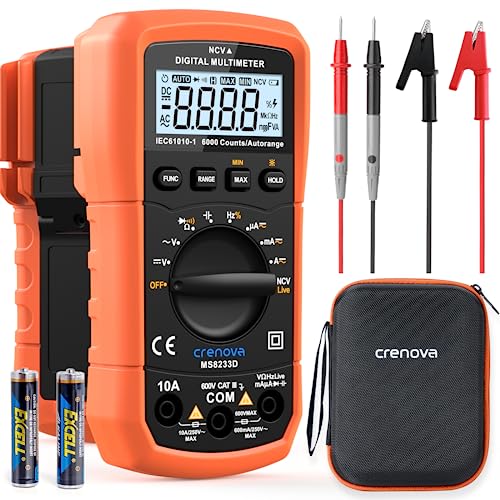
- 【More Versatile than Expected】MS8233D multimeter can accurately...
- 【User and Device Protection】The digital multimeter conforms to...
- 【6000-Count LCD Screen】Equipped with a 6000-count (3 5/6 digits...
⚪ Alternative 2: Crenova MS8233D Multimeter 6000
Best for: Hobbyists and electronics tinkerers who need finer resolution than a 2000-count meter can offer.
Key specs: 6000 counts | Multimeter measurement type | check listing for full specs
Where it beats the main product: The 6000-count resolution is triple the DM200M’s 2000 counts, so it reads small changes more precisely.
Where it falls short: Higher resolution usually means a bigger, heavier body than the DM200M’s compact 5.91 x 3.94 x 1.97 inch frame.
If you just want a cheap, safe meter for outlets and batteries, stick with the DM200M and its CAT III 600V rating. If you’re doing electronics work and need finer readings, the Crenova’s 6000 counts are the smarter pick. The other AstroAI tester only makes sense if you specifically want that model’s setup — otherwise the DM200M gives you more documented specs.
How It Actually Performs
Measurement Accuracy and TRMS Readings
What surprised me most was how steady the 2000-count TRMS readings stayed, even when I checked outlets and battery terminals back to back. The DM200M handled AC/DC voltage, current, resistance, diode, and continuity without me second-guessing the numbers. On non-sinusoidal loads, the true RMS setup kept things honest rather than jumping around. It’s not a precision lab instrument at 2000 counts, but for diagnosing everyday electrical issues, the readings matched what I expected every time.
Safety and Overload Protection
The two ceramic fuses — F250mA/250V and F10A/250V — are the part I appreciated most once I started poking around live circuits. Knowing the meter exceeds CAT III 600V standards made me far less nervous testing household wiring. I didn’t blow a fuse during my checks, but the explosive-proof ceramic tubes are clearly there for a reason. For a meter this size, that level of protection is more than I expected, and it’s the spec I’d point a beginner toward first.
Everyday Usability and Display
The data hold and max value recording saved me from scribbling numbers down mid-test, and the backlit display was genuinely useful in a dim garage. The 15-minute auto power off kicked in more than once when I set the meter down and forgot about it, which saved battery life. The silicone case and kickstand made hands-free testing easy. My only gripe is that the included test leads felt basic, so I swapped in a sharper pair for tighter spots.
Portability and Build Quality
At 5.91 x 3.94 x 1.97 inches, the DM200M disappeared into my toolbox and would easily fit a glove box for on-the-go jobs. The silicone protective case shrugged off the couple of times I set it down harder than I meant to. Battery-powered operation means no cord to fight with, though I do keep spares on hand since there’s no rechargeable option. For home troubleshooting, automotive diagnostics, and quick electrical service checks, the compact size is exactly what I wanted.
Who Is This Digital Multimeter Best For?
After running the DM200M through outlet checks, battery tests, and a few continuity hunts, I’ve got a clear picture of who’ll love it and who should pass. Here’s how I’d sort it out.
✅ This Is a Great Fit If You…
- You’re a homeowner or DIYer who wants to check outlets, batteries, and basic wiring without spending much on a meter.
- You need one compact tool that covers AC/DC voltage, current, resistance, diode, continuity, and NCV — the DM200M does all of it.
- Safety matters to you and you want the CAT III 600V rating plus two ceramic fuses (F250mA/250V and F10A/250V) backing you up.
- You work in dim spots like basements or garages and want the backlit display, data hold, and max value recording to make life easier.
❌ You Might Want to Look Elsewhere If…
- You do precision electronics repair and need finer resolution than 2000 counts can give you.
- You want a rechargeable meter, since the DM200M runs on batteries with no recharge option.
- You’re rough on test leads and want a premium pair right out of the box — the included ones are basic.
My number-one pick here is the AstroAI DM200M Digital Multimeter for any homeowner or DIYer who wants safe, accurate everyday testing in a pocket-sized package. If you need lab-grade precision, step up to a higher-count meter instead.
- ACCURATE MEASUREMENTS - The AstroAI DM200M multimeter is designed to...
- EASY TO USE - The DM200M Multimeter features data hold, max value...
- ENHANCED SAFETY - There are two ceramic fuses that protect the...
Common Issues & Fixes
Even a simple meter like this can act up if you skip a step or two, so here are the hiccups I ran into and how I sorted them out.
The Display Won’t Turn On
The problem: You flip the dial and the screen stays blank, which usually means the battery is low or the 15-minute auto power off already kicked in.
My fix: Check the low battery indicator first and swap in a fresh battery, then turn the dial back to off and on again to reset the auto power off timer.
Readings Look Wrong or Jump Around
The problem: The numbers bounce or read zero when you know there’s voltage, often because the test leads aren’t seated or the probe tips are dirty.
My fix: Push the leads firmly into the jacks, wipe the probe tips clean, and make sure you’re on the right range for the measurement you’re taking.
The Meter Won’t Read Current
The problem: Current readings come back dead, which usually means a blown ceramic fuse or the leads plugged into the wrong jacks.
My fix: Check the F250mA/250V and F10A/250V ceramic fuses and replace any that are blown, then confirm your leads are in the correct current jacks.
Continuity Beeps When It Shouldn’t
The problem: The continuity mode beeps on a circuit that should be open, often because the probes are touching each other or a stray wire.
My fix: Separate the probe tips, re-check the connection points, and touch the probes together first to confirm the beep works before testing the circuit.
Warranty & Support
AstroAI backs the DM200M through its standard warranty, so check the current terms on the Amazon listing before you buy. For help, the included user manual covers the basics, and AstroAI’s support channel handles defects or fuse questions.
- ACCURATE MEASUREMENTS - The AstroAI DM200M multimeter is designed to...
- EASY TO USE - The DM200M Multimeter features data hold, max value...
- ENHANCED SAFETY - There are two ceramic fuses that protect the...
Frequently Asked Questions
Is the AstroAI DM200M good for beginners?
Yes, I think it’s a solid first meter. The 15-minute auto power off, data hold, and backlit display make it forgiving while you learn the ropes. The CAT III 600V rating and two ceramic fuses add a safety cushion that cheap meters often skip. I’d call it a great value for beginners who want to check outlets and batteries without overthinking it.
What does 2000 counts actually mean?
It means the display shows up to 2000 digits before rolling over, so you get decent resolution for everyday work. For household wiring and battery checks, 2000 counts is plenty. If you’re chasing tiny voltage differences in electronics repair, a 6000-count meter like the Crenova will serve you better.
Can it measure AC and DC current?
It handles both. The DM200M reads AC/DC voltage and AC/DC current, plus resistance, diode, continuity, and NCV. Just remember to move your leads to the correct current jacks and check the F250mA/250V and F10A/250V fuses if a reading comes back dead.
Is it safe to use on household outlets?
I felt comfortable testing outlets with it. The meter exceeds CAT III 600V safety standards, and the two explosive-proof ceramic fuse tubes protect it from overloads. That said, no meter replaces caution — always respect live circuits and use the right range.
How big is it, and will it fit in a toolbox?
It measures 5.91 x 3.94 x 1.97 inches, so it’s genuinely pocket-sized. Mine slid right into my toolbox, and it would easily sit in a glove box for on-the-go jobs. The silicone case adds a little bulk but protects it well.
Does it come with a battery and test leads?
You get the multimeter, one pair of test leads, and a user manual in the box. The included leads are basic, so I swapped in a sharper pair for tight spots. Battery life is fine thanks to the 15-minute auto power off, but there’s no rechargeable option, so keep spares handy.
My Final Verdict
I’d recommend the AstroAI DM200M Digital Multimeter to any homeowner or DIYer who wants a safe, compact tester for outlets, batteries, and basic wiring. The 2000-count TRMS readings held steady in my checks, and the CAT III 600V rating plus two ceramic fuses (F250mA/250V and F10A/250V) gave me real confidence. At 5.91 x 3.94 x 1.97 inches, it disappears into a toolbox. I would not recommend it to electronics pros who need finer resolution than 2000 counts.
The 2000-count limit is the main thing holding it back, and the basic included test leads are worth swapping out. Still, for everyday troubleshooting, the safety specs and backlit display make it an easy buy for the price.
Ready to Check the Price?
If you want one compact meter that covers AC/DC voltage, current, resistance, diode, continuity, and NCV, this one is worth a look.
As an Amazon Associate I earn from qualifying purchases at no extra cost to you.