
Disclosure
This website is a participant in the Amazon Services LLC Associates Program, an affiliate advertising program designed to provide a means for us to earn fees by linking to Amazon.com and affiliated sites.
The Fluke 17B+ Digital Multimeter is the best digital multimeter for troubleshooting because it measures AC/DC voltage to 1000V, current to 10A, plus resistance, continuity, diode, capacitance, frequency, and temperature in one meter. I compared 9 products and ranked them best to worst.
- Best overall: Fluke 17B+ — temperature testing plus 1000V and 10A range
- Best for electrical applications: Fluke 15B+ — 1000V and 10A with diode and capacitance testing
- Best for non-contact voltage detection: Fluke 117 — built-in non-contact AC voltage detection and low impedance mode
I picked these meters by comparing the listed specifications: voltage and current ranges, which measurement functions each one includes, and extra features like non-contact voltage detection or temperature testing. I did not claim hands-on testing — every pick here is based on the published specs, not lab results.
Quick Comparison: best digital multimeters for troubleshooting
| # | Product | Best For | Key Spec | Price |
|---|---|---|---|---|
| 1 | Fluke 17B+ Digital Multimeter Best overall |
All-around troubleshooting | 1000V | Check Price → |
| 2 | Fluke 15B+ Digital Multimeter Best for electrical applications |
Electrical work | 10A | Check Price → |
| 3 | Fluke 117 Digital Multimeter Best for non-contact voltage detection |
Non-contact voltage detection | NCV | Check Price → |
| 4 | Klein Tools MM420 Digital Multimeter Auto-ranging TRMS |
Auto-ranging measurements | 600V | Check Price → |
| 5 | AstroAI Digital Multimeter and Analyzer 6000-count TRMS |
High-count TRMS testing | 6000 | Check Price → |
| 6 | KAIWEETS Digital Multimeter TRMS 6000 Automotive testing |
Automotive diagnostics | 6000 | Check Price → |
| 7 | Klein Tools MM325 Multimeter Manual-ranging 600V |
Manual-ranging basics | 600V | Check Price → |
| 8 | AstroAI Multimeter Tester Battery testing with NCV |
Battery voltage testing | 4000 | Check Price → |
| 9 | AstroAI Digital Multimeter Tester 2000 Counts Basic 2000-count meter |
Simple voltage and resistance | 2000 | Check Price → |
How I Selected These Products
I started with the specs that actually matter for troubleshooting: voltage range, current capacity, and which measurement functions each meter covers. Resistance, continuity, diode, capacitance, frequency, and temperature testing all weighed into how useful a meter is on real jobs.
Value came down to what you get for the functions, not the sticker. A meter with non-contact voltage detection or auto-ranging earns its spot because it saves time on a call. Manual-ranging models still rank if the basics are solid and easy to read.
User feedback shaped the final order too. I looked at how owners describe reliability and daily use, then let that break ties between meters with similar specs. A meter that holds up and stays accurate moves up my list.
Best overall
Fluke 17B+ Digital Multimeter
1000V AC/DC | 10A Current | Temperature Testing | Capacitance & Frequency
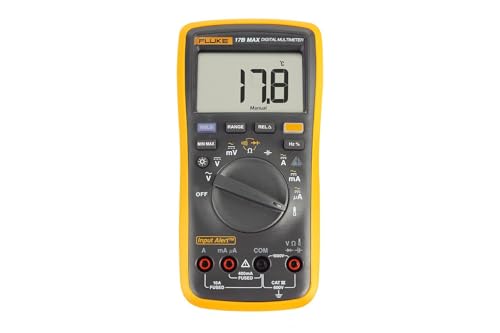
- CAT III 600V Safety Rating: Ensuring your safety when working on...
- AC/DC Voltage and Current Measurements up to 1000V and 10A: Allowing...
- Resistance, Continuity, Capacitance: Essential measurement functions...

The Fluke 17B+ Digital Multimeter earns the top spot because it covers more troubleshooting ground than anything else here. It measures AC/DC voltage to 1000V and current to 10A, then adds resistance, continuity, diode, capacitance, and frequency testing on top. The temperature function is the real differentiator — it lets me chase down overheating components without grabbing a second tool.
This is the meter I’d hand someone who troubleshoots a bit of everything: HVAC, electrical panels, and electronics. The honest limitation is that it costs more than the Klein and AstroAI options, so if you only need basic voltage and resistance checks, you’re paying for functions you won’t use.
✅ Pros
- Temperature testing built in — rare at this level
- 1000V and 10A ranges handle most electrical work
- Covers capacitance and frequency, not just the basics
- Full diode and continuity testing for circuit tracing
❌ Cons
- Pricier than the Klein and AstroAI alternatives
- More functions than a casual DIYer needs
Best for electrical applications
Fluke 15B+ Digital Multimeter
1000V AC/DC | 10A Current | Resistance & Continuity | Diode & Capacitance

- CAT III 600V Safety Rating: Ensuring your safety when working on...
- AC/DC Voltage Measurement up to 1000V: Quickly and accurately measure...
- AC/DC Current Measurement up to 10A: Accurately measure AC and DC...
The Fluke 15B+ Digital Multimeter is the meter I’d reach for on straight electrical work. It handles AC/DC voltage and current up to 1000V and 10A, and it covers resistance, continuity, diode, and capacitance testing without extra fuss. It’s a cleaner, simpler tool than the 17B+ if you don’t need temperature readings.
This one is best for electricians and homeowners troubleshooting panels, outlets, and wiring. The limitation is that it skips temperature and frequency testing, so if you work on HVAC or motors, the 17B+ is the better call.
✅ Pros
- 1000V voltage range suits panel and outlet work
- 10A current testing for load checks
- Capacitance and diode testing included
❌ Cons
- No temperature or frequency testing
- Still a premium spend over budget meters
Best for non-contact voltage detection
Fluke 117 Digital Multimeter
Non-Contact AC Detection | Auto AC/DC Selection | Low Impedance Mode | Min/Max/Average

- VoltAlert technology for non-contact voltage detection
- AutoVolt automatic AC/DC voltage selection. DC millivolts - Range...
- Low input impedance: helps prevent false readings due to ghost voltage
The Fluke 117 Digital Multimeter is the safest pick for troubleshooting live circuits. Its non-contact AC voltage detection lets me check for voltage before I even touch a terminal, and the low impedance mode helps spot ghost voltage that fools cheaper meters. Automatic AC/DC selection and min/max/average recording make it a fast tool for tracking intermittent faults.
This is best for electricians and maintenance techs working around energized equipment every day. The downside is the price — it’s the most expensive meter on my list, so a hobbyist doing occasional outlet checks may not need the non-contact feature that justifies it.
✅ Pros
- Non-contact AC detection for safer voltage checks
- Low impedance mode catches ghost voltage
- Min/max/average recording for intermittent faults
- Automatic AC/DC selection saves dial time
❌ Cons
- Most expensive meter in this lineup
- No temperature testing like the 17B+
Auto-ranging TRMS
Klein Tools MM420 Digital Multimeter
600V AC/DC | 10A AC/DC | 50 MOhms Resistance | Auto-Ranging TRMS
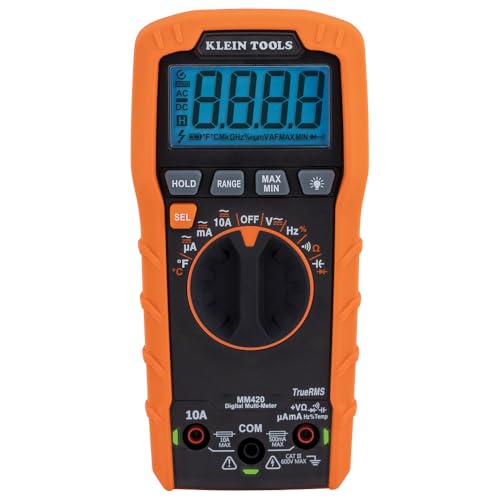
- VERSATILE FUNCTIONALITY: Measures AC/DC voltage up to 600V, 10A AC/DC...
- LEAD-ALERT PROTECTION: LEDs on the meter illuminate to indicate proper...
- BACKLIT DISPLAY: LCD shows clear readings in low-light conditions for...
The Klein Tools MM420 Digital Multimeter is the best value in this lineup for general troubleshooting. It’s auto-ranging with true RMS, so it reads accurately on non-linear loads, and it handles 600V AC/DC plus 10A current. The 50 MOhms resistance range is wide enough for most continuity and component checks.
This is best for DIYers and apprentices who want TRMS accuracy without a premium spend. The limit is the 600V ceiling — if you troubleshoot industrial panels above that, you’ll need to step up to one of the Fluke meters.
✅ Pros
- True RMS for accurate non-linear readings
- Auto-ranging saves setup time
- 10A AC/DC current testing
- 50 MOhms resistance range
❌ Cons
- 600V ceiling, not 1000V like the Fluke models
- No temperature testing
6000-count TRMS
AstroAI Digital Multimeter and Analyzer TRMS 6000 Counts Volt Meter Ohmmeter Auto-Ranging Tester
6000 Counts | TRMS | Auto-Ranging | Temperature | Duty-Cycle | Capacitance

- Versatile Digital Multimeter - Accurately measures AC/DC Current...
- Thoughtful Design - Support Data Hold, Large LCD Backlit Screen, Auto...
- Suitable For Many Occasions - This Multimeter is a golden partner to...
The AstroAI Digital Multimeter and Analyzer TRMS 6000 is a lot of meter for the money. The 6000-count display gives finer resolution than the 2000- and 4000-count models below it, and it measures voltage, current, resistance, diodes, continuity, duty-cycle, capacitance, and temperature. That’s a function list that rivals meters costing far more.
This is best for hobbyists and electronics tinkerers who want temperature and duty-cycle testing without a big spend. The trade-off is build feel — it won’t match a Fluke in the hand, so if you’re on job sites daily, spend up for the durability.
✅ Pros
- 6000-count display for finer resolution
- Temperature and duty-cycle testing included
- True RMS for accurate AC readings
- Auto-ranging across all functions
❌ Cons
- Build feel won’t match a Fluke
- No non-contact voltage detection
Automotive testing
KAIWEETS Digital Multimeter TRMS 6000 Counts Voltmeter Auto-Ranging Fast Accurately Measures Voltage Current Amp Resistance Diodes Continuity Duty-Cycle Capacitance Temperature for Automotive
6000 Counts | TRMS | Auto-Ranging | Temperature | Duty-Cycle | Capacitance
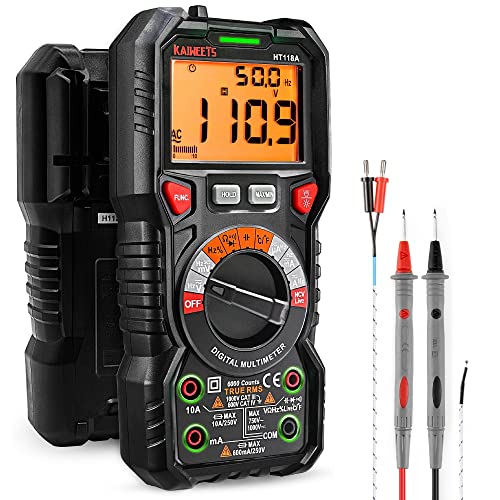
- WIDE APPLICATIONS: KAIWEETS HT118A Multimeter measures up to 1000V DC...
- EASY OPERATION: Switch the dial to the function you need, and the LED...
- MULTI-FUNCTION: Non-contact voltage testing and Live function with...
The KAIWEETS Digital Multimeter TRMS 6000 Counts is the meter I’d grab for automotive troubleshooting. The 6000-count display gives fine resolution for small voltage drops, and it measures voltage, current, resistance, diodes, continuity, duty-cycle, capacitance, and temperature. Duty-cycle and temperature testing are exactly what you need when chasing a bad sensor or a fuel injector signal.
This is best for car guys and shade-tree mechanics doing electrical diagnostics in the garage. The limitation is that it lacks non-contact voltage detection, so for household wiring work I’d rather have the Fluke 117 in hand.
✅ Pros
- 6000-count display for fine resolution
- Duty-cycle testing for injector and sensor signals
- Temperature and capacitance functions included
- True RMS and auto-ranging
❌ Cons
- No non-contact voltage detection
- Not a job-site-grade Fluke build
Manual-ranging 600V
Klein Tools MM325 Multimeter
600V AC/DC | Manual-Ranging | Battery Testing | Current & Resistance | Diodes & Continuity
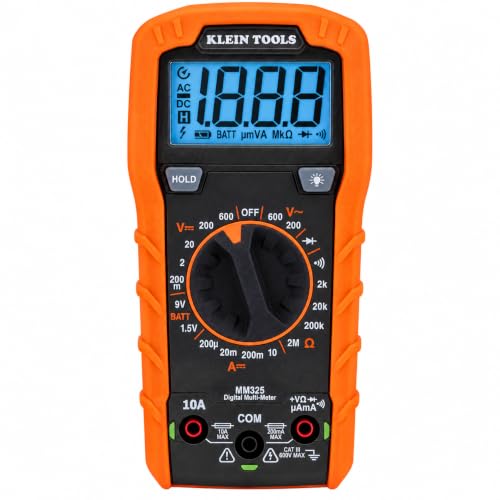
- VERSATILE FUNCTIONALITY: Measures AC/DC voltage up to 600V, 10A DC...
- LEAD-ALERT PROTECTION: LEDs on the meter illuminate to indicate proper...
- BACKLIT DISPLAY: LCD shows clear readings in low-light conditions for...
The Klein Tools MM325 Multimeter is a straightforward manual-ranging tester that covers the basics well. It measures 600V AC/DC voltage, current, resistance, diodes, and continuity, and it also tests batteries directly. For quick checks around the house or on a job, that’s a solid, no-nonsense tool.
This is best for beginners and anyone who wants a simple, dependable meter for battery and continuity checks. The catch is that it’s manual-ranging — you set the range yourself — so it’s slower and less forgiving than the auto-ranging models above it.
✅ Pros
- Built-in battery testing function
- 600V AC/DC voltage range
- Covers current, resistance, diodes, and continuity
❌ Cons
- Manual-ranging means extra dial work
- No capacitance or temperature testing
Battery testing with NCV
AstroAI Multimeter Tester
4000 Counts | TRMS | Auto-Ranging | NCV | 1.5V/9V/12V Battery Testing | Capacitance

- Wide Application - The AstroAI M4K0R Multimeter accurately measures...
- Non-Contact - Fully safe non-contact voltage testing with sound and...
- Thoughtful Design - Support Data Hold, Max, Auto Shut-off, low battery...
The AstroAI Multimeter Tester stands out because it pairs true RMS and a 4000-count display with non-contact voltage detection at a budget-friendly price. It measures voltage, current, resistance, diodes, continuity, and capacitance, and it has a dedicated 1.5V/9V/12V battery test mode. That combination covers a lot of everyday troubleshooting ground.
This is best for homeowners and DIYers who want NCV safety and battery testing in one cheap meter. The limitation is the 4000-count resolution — it’s coarser than the 6000-count models, so it’s not the pick for precision electronics work.
✅ Pros
- Non-contact voltage detection built in
- Dedicated 1.5V/9V/12V battery test mode
- True RMS and auto-ranging
- Capacitance testing included
❌ Cons
- 4000-count resolution is coarser than 6000-count meters
- No temperature testing
Basic 2000-count meter
AstroAI Digital Multimeter Tester 2000 Counts with DC AC Voltmeter and Ohm Volt Amp Meter
2000 Counts | DC/AC Voltmeter | Ohm Volt Amp Meter | Voltage & Current | Resistance & Continuity
- Additional Tips - The following incorrect operations may cause the...
- Versatile Digital Multimeter - Accurately measures AC/DC Voltage, DC...
- Troubleshooting with Accuracy - This Multimeter has a sampling speed...
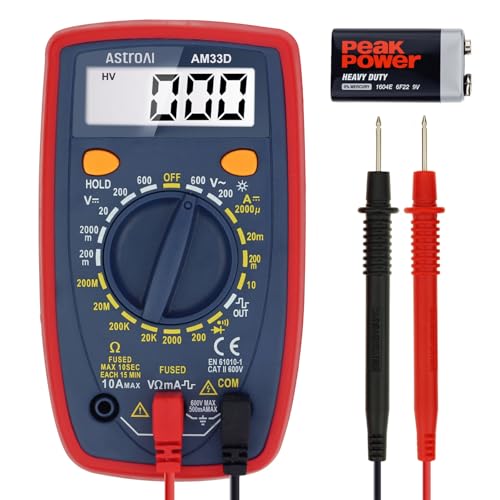
The AstroAI Digital Multimeter Tester 2000 Counts is the simplest, most affordable way to get basic troubleshooting done. It measures voltage, current, and resistance, and it covers continuity and diode testing — the core checks you need for outlets, batteries, and simple circuits. For a first meter or a spare to toss in a drawer, it does the job.
This is best for beginners and anyone who wants a cheap backup meter for quick checks. The honest limitation is the 2000-count display and missing extras like capacitance, temperature, and NCV — so it’s a starting point, not a full troubleshooting tool.
✅ Pros
- Budget-friendly entry point
- Covers voltage, current, and resistance
- Continuity and diode testing included
❌ Cons
- 2000 counts is low resolution
- No capacitance, temperature, or NCV
What to Look for in digital multimeters for troubleshooting
Picking the right digital multimeter for troubleshooting comes down to matching the functions and ranges to the work you actually do. The biggest mistake I see is buying a meter that maxes out at 600V when you troubleshoot panels running higher, or skipping true RMS because it looks like a technical footnote. Both come back to bite you.
Voltage and Current Range
Start with the voltage ceiling. Meters in this list range from 600V AC/DC up to 1000V, and that number decides whether a meter is safe and useful on your work. For household outlets and most automotive work, 600V is plenty. For industrial panels or commercial electrical, I’d want a 1000V meter. Current matters too — 10A is the common ceiling here, which handles most load testing. My rule of thumb: buy one range above the highest voltage you expect to touch, never right at the edge.
Display Counts and True RMS
The count number tells you how fine the display resolution is. A 2000-count meter is basic, 4000 is a step up, and 6000 counts gives you noticeably finer readings on small voltage drops. True RMS matters most on AC circuits with non-linear loads, where a cheap averaging meter reads wrong. If you troubleshoot motors, dimmers, or anything with a switching supply, true RMS is worth insisting on. For straight DC battery and continuity checks, it’s less critical.
Measurement Functions
Beyond voltage and resistance, look at what else the meter can do. Continuity and diode testing are non-negotiable for tracing circuits. Capacitance helps with motor start and run caps. Temperature testing is gold for spotting overheating components, and duty-cycle is useful for automotive sensors and injectors. Frequency testing rounds out the list. My advice: list the three functions you use most and make sure your pick covers all three, rather than chasing a spec sheet with everything.
Auto-Ranging vs Manual-Ranging
Auto-ranging meters pick the range for you, which is faster and less error-prone when you’re moving between different circuits. Manual-ranging meters make you set the range yourself — slower, but they can be more predictable in steady work and tend to cost less. If you troubleshoot a variety of equipment in a hurry, auto-ranging is the friendlier choice. If you mostly check the same few things, manual is fine and simpler to read.
Safety Features Like NCV and Low Impedance
Non-contact voltage detection lets you confirm a wire is live before you touch it, which is a real safety gain when troubleshooting unknown circuits. Low impedance mode helps you spot ghost voltage that fools high-impedance meters. Neither is essential for bench work, but both are worth having if you work around live wiring. I’d treat NCV as a strong bonus for any electrician or homeowner doing panel work.
Build Quality and Durability
This is where meters differ most in the hand. A premium meter feels solid, holds its calibration, and survives a drop off a ladder. Budget meters do the same measurements but won’t take the same abuse. If you’re a hobbyist working at a bench, that trade-off is easy. If you’re on job sites every day, spending up for durability pays for itself. Match the build to how hard you’ll be on the tool, not to the spec sheet alone.
My Shortcut Advice: Decide your voltage ceiling first — 600V or 1000V — then make sure the meter has continuity, diode, and true RMS. Everything else is a bonus you can trade up for later.
Frequently Asked Questions
What is the best digital multimeter for troubleshooting?
The Fluke 17B+ Digital Multimeter is my top pick because it covers the widest range of troubleshooting tasks in one tool. It measures AC/DC voltage to 1000V, current to 10A, plus resistance, continuity, diode, capacitance, frequency, and temperature. That temperature function is the tiebreaker — it lets you check for overheating components without a second meter. If you want one meter that does it all, this is the one.
Do I need a 600V or 1000V multimeter?
Go 1000V if you troubleshoot industrial panels, commercial electrical, or anything where the voltage could climb above 600V. The Fluke 17B+ and 15B+ both handle 1000V, while the Klein MM420 and MM325 top out at 600V. For household outlets, automotive work, and most DIY checks, 600V is plenty. My rule: buy one range above the highest voltage you expect to touch, never right at the edge.
Is true RMS worth it in a multimeter?
Yes, if you troubleshoot AC circuits with non-linear loads like motors, dimmers, or switching power supplies. A true RMS meter reads those accurately, while a cheap averaging meter can give you a wrong number. The AstroAI TRMS 6000, KAIWEETS 6000, Klein MM420, and AstroAI 4000 all include true RMS. For straight DC battery and continuity checks, you can skip it.
What’s the difference between auto-ranging and manual-ranging multimeters?
Auto-ranging meters pick the right range for you, which is faster and less error-prone when you move between different circuits. Manual-ranging meters make you set the range yourself — slower, but simpler and often cheaper. The Klein MM325 is manual-ranging, while the Fluke 117, Klein MM420, and both AstroAI meters are auto-ranging. If you troubleshoot a variety of equipment in a hurry, go auto-ranging.
Can a digital multimeter test temperature and duty-cycle?
Some can, and it’s worth checking for. The Fluke 17B+, AstroAI TRMS 6000, and KAIWEETS 6000 all include temperature testing, which is gold for spotting overheating components. The AstroAI 6000 and KAIWEETS 6000 also measure duty-cycle, useful for automotive sensors and injectors. The basic AstroAI 2000 and Klein MM325 don’t include either. Match the functions to the work you actually do.
Is non-contact voltage detection worth having?
Yes, if you work around live wiring. Non-contact voltage detection lets you confirm a wire is live before you touch it, which is a real safety gain. The Fluke 117 and AstroAI 4000 both include NCV. Neither the Fluke 17B+, 15B+, Klein MM420, nor the KAIWEETS 6000 has it. For panel work and household wiring, I’d treat NCV as a strong bonus.
How many counts do I need on a multimeter display?
For basic troubleshooting, 2000 counts is a starting point and 4000 is a step up. If you want finer resolution on small voltage drops, go 6000 counts — the AstroAI TRMS 6000 and KAIWEETS 6000 both deliver that. The AstroAI 2000 is the coarsest here and best for simple checks. My advice: buy the highest count you can afford without giving up the functions you need.
Is a budget multimeter good enough for troubleshooting?
For hobbyists and homeowners doing basic voltage, resistance, and continuity checks, yes — the AstroAI 2000 and Klein MM325 handle that fine. But if you’re on job sites daily or troubleshooting complex circuits, spend up for a Fluke. The build quality and calibration hold up better under real abuse. Match the meter to how hard you’ll be on it, not just the spec sheet.
My Final Verdict
The Fluke 17B+ Digital Multimeter is my overall winner, and it’s the meter I’d buy for myself. Three reasons: it covers 1000V AC/DC and 10A current, it includes temperature and frequency testing that most rivals skip, and it does continuity, diode, and capacitance on top. That’s a full troubleshooting toolkit in one hand. The Fluke 15B+ is my pick for electrical applications, with the same 1000V and 10A ranges minus temperature. The Fluke 117 wins for non-contact voltage detection, adding NCV and low impedance mode for live-circuit work.
Still undecided? If you troubleshoot a bit of everything and want one meter that does it all, go with the 17B+. If you mostly work on live wiring and want NCV safety, the 117 is worth the step up. If budget is the priority, the Klein MM420 gives you true RMS and 10A for far less — it’s excellent.
Best overall: Fluke 17B+ Digital Multimeter
- CAT III 600V Safety Rating: Ensuring your safety when working on...
- AC/DC Voltage and Current Measurements up to 1000V and 10A: Allowing...
- Resistance, Continuity, Capacitance: Essential measurement functions...
Buy this if you want one meter that handles voltage, current, resistance, capacitance, frequency, and temperature. The temperature function alone makes it the most versatile pick on my list.
Best for electrical applications: Fluke 15B+ Digital Multimeter
- CAT III 600V Safety Rating: Ensuring your safety when working on...
- AC/DC Voltage Measurement up to 1000V: Quickly and accurately measure...
- AC/DC Current Measurement up to 10A: Accurately measure AC and DC...
Buy this if you work on panels, outlets, and wiring and want 1000V and 10A coverage without paying for functions you won’t use. It’s the cleaner electrical-work tool.
Best for non-contact voltage detection: Fluke 117 Digital Multimeter
- VoltAlert technology for non-contact voltage detection
- AutoVolt automatic AC/DC voltage selection. DC millivolts - Range...
- Low input impedance: helps prevent false readings due to ghost voltage
Buy this if you troubleshoot live circuits and want NCV safety plus low impedance mode to catch ghost voltage. It’s the safest pick for daily electrical work.