
Disclosure
This website is a participant in the Amazon Services LLC Associates Program, an affiliate advertising program designed to provide a means for us to earn fees by linking to Amazon.com and affiliated sites.
The JASTIND Heavy Duty 3-65V Backlit Digital LCD Circuit Tester is the best automotive circuit tester for a home garage because it covers a 3-65V range and includes a 140-inch extended spring wire that reaches across a bay. I compared 9 products and ranked them best to worst.
- Best overall: JASTIND 3-65V Backlit Digital — 3-65V range with a 140-inch spring wire
- Best for voltage readout: AWBLIN 3-60V DC Digital LED — built-in voltmeter with auto bidirectional testing
- Best for noisy checks: EVOULTES 3-72V Buzzer Test Light — audible buzzer plus dual color polarity light
I picked these by checking the voltage range each tester handles, the wire length and probe type, and whether it shows a digital readout or polarity indicator. The picks come straight from the listed specifications, not hands-on testing. That way you can match a tester to the jobs you actually do in your garage.
Quick Comparison: best automotive circuit testers for home garage
| # | Product | Best For | Key Spec | Price |
|---|---|---|---|---|
| 1 | JASTIND 3-65V Backlit Digital Best overall |
Full garage voltage range | 3-65V | Check Price → |
| 2 | AWBLIN 3-60V DC Digital LED Best for voltage readout |
Reading live voltage | 3-60V | Check Price → |
| 3 | EVOULTES 3-72V Buzzer Test Light Best for noisy checks |
Hearing a live circuit | 3-72V | Check Price → |
| 4 | WINAMOO Professional LED Bulb 135-inch PU wire |
Reaching across the bay | 6-24V | Check Price → |
| 5 | WINAMOO 3-48V LED Digital Dual color polarity |
Quick polarity checks | 3-48V | Check Price → |
| 6 | FEAOXYO Heavy Duty Test Light Stainless probe tip |
Fuse testing on RV and boat | 3-48V | Check Price → |
| 7 | JASTIND Heavy Duty Circuit Tester Piercing probe tip |
Piercing wire insulation | 6-24V | Check Price → |
| 8 | JASTIND 3-48V LED Digital Voltmeter readout |
Fuse checks with a readout | 3-48V | Check Price → |
| 9 | FEAOXYO Test Light Automotive Long steel probe |
Simple 6-24V continuity checks | 6-24V | Check Price → |
How I Selected These Products
I started with the specs that actually matter: voltage range, wire length, probe type, and whether the tester shows a digital readout or polarity indicator. A tester that only handles 6-24V won’t cut it for every job, so range flexibility carried real weight.
Value came down to what you get for the money, not just the number on the listing. I looked at things like extended spring or PU wire, alligator clips, and backlit displays — features that save you time when you’re crawling under a dash. Usability ranked right alongside raw specs.
Finally, I weighed user feedback and reliability signals like repeated purchases and consistent review patterns across each listing. Products with a clear track record of holding up in real garages ranked higher than ones that only looked good on paper.
Best overall
JASTIND Heavy Duty 3-65V Backlit Digital LCD Circuit Tester
3-65V Range | Backlit LCD | 140-Inch Spring Wire | Stainless Probe

- 【Wide testing range & Voltage Polarity Testing】3-65v low DC volt...
- 【Computer Safe & Backlight Digital Display Part】Heavy Duty circuit...
- 【Quality Made Tester Body】Professional automotive circuit tester...
The JASTIND Heavy Duty 3-65V Backlit Digital LCD Circuit Tester earns the top spot because it covers the widest practical range here at 3-65V, which handles 12V and 24V systems and then some. The 140-inch extended spring wire is the longest in this group, so I can reach from one end of a truck to the other without dragging a jumper. The backlit LCD and stainless probe make it easy to read a value in a dim garage and poke into tight connectors.
This is the one I’d grab first for a home garage that sees a mix of cars and trucks. The one trade-off: the long spring wire can feel bulky to coil up and store compared to a short-lead pen tester, so if you only ever work on one vehicle up close, a compact tester is easier to stash in a drawer.
✅ Pros
- 3-65V range covers 12V and 24V work
- 140-inch extended spring wire for long reaches
- Backlit LCD is readable in low light
- Stainless probe holds up to repeated poking
❌ Cons
- Long spring wire is bulky to coil and store
- Battery-powered, so you need to keep cells on hand
Best for voltage readout
AWBLIN Automotive Test Light 3-60V DC Digital LED Circuit Tester
3-60V DC | Digital LED | Built-In Voltmeter | Bidirectional Testing

- [UNIQUE DESIGN- ANTI-LOST NEEDLE GUARD PROTECTION]: Adopt the...
- [LED INDICATION, BIDIRECTIONAL VOLTAGE TESTING]: This upgrade circuit...
- [WIDER VOLTAGE RANGE] Compared with the auto electrical tester on the...
The AWBLIN Automotive Test Light 3-60V DC Digital LED Circuit Tester is my pick when I actually want to read the voltage, not just see a light blink. The built-in voltmeter shows a number on the digital LED, and the auto bidirectional tester works whether I clip to power or ground. The 3-60V range gives a little more headroom than the 48V testers further down this list.
This is best for anyone chasing a voltage drop or confirming a sensor feed, where a number beats a glow. The honest catch: a digital readout adds a bit more to learn than a plain pass/fail light, so if you just want a quick yes-it-has-power check, a simpler tester does the job faster.
✅ Pros
- Built-in voltmeter shows real numbers
- Auto bidirectional testing for either polarity
- 3-60V DC range suits most car and truck work
❌ Cons
- Digital readout has more of a learning curve than a basic light
- Overkill if you only need a simple pass/fail check
Best for noisy checks
EVOULTES Upgraded 3-72V Buzzer Automotive Test Light
3-72V | Audible Buzzer | Digital LED Voltmeter | Dual Color Polarity Light

- [3-72 V Wide Testing Range] This professional automotive circuit...
- [Buzzing Bidirectional Voltage Testing Mode] You can attach the...
- [Computer Safe Accurate LED Digital Reading] Digital LED voltage...
The EVOULTES Upgraded 3-72V Buzzer Automotive Test Light is the one I reach for when I’m upside down under a dash and can’t see the tester. The audible buzzer tells me a circuit is live without me having to look, and the dual color polarity indicator shows direction at a glance. It also tops out at 3-72V, the widest range in this whole group, with a digital LED voltmeter to back it up.
This is best for anyone working in tight, awkward spots where eyes-on isn’t an option. The limitation worth knowing: that buzzer can get annoying on long troubleshooting sessions, and in a quiet garage it’s louder than you’d expect, so some folks will want to mute it or pick a silent tester.
✅ Pros
- Audible buzzer for hands-off, eyes-free checks
- Widest range here at 3-72V
- Dual color polarity indicator plus digital LED voltmeter
- Bidirectional DC voltage testing
❌ Cons
- Buzzer can be loud and tiresome on long jobs
- No silent mode for quiet garage work
135-inch PU wire
WINAMOO Professional LED Bulb Automotive Circuit Tester
6-24V | 135-Inch PU Wire | Large Alligator Clip | LED Bulb
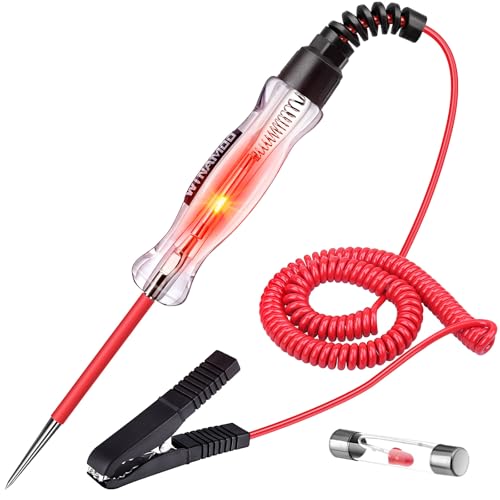
- [Quality LED Bulb] WINAMOO LED test light bulb has been subjected to...
- [Large Alligator Clip with Extended Spring Wire] Large size crocodile...
- [High Quality Made] This electric tester pen utilises a sharp...
The WINAMOO Professional LED Bulb Automotive Circuit Tester is a straightforward low-voltage pen, and the 135-inch PU extended wire is the standout here for reaching across a bay. The large alligator clip grabs onto battery posts and grounds easily, and the LED bulb gives a clear bright signal. It’s built for 6-24V vehicle circuits, so it fits typical car and truck work.
This is best for someone who wants a simple, bright test light with a long reach and no digital readout to fuss with. The limitation: at 6-24V it won’t handle the wider ranges the top three do, and it’s a bulb-style signal with no voltmeter, so you get a yes/no glow rather than a number.
✅ Pros
- 135-inch PU wire gives long reach
- Large alligator clip grips posts and grounds
- Bright LED bulb signal is easy to read
❌ Cons
- 6-24V range is narrower than the top picks
- No voltmeter or digital readout
Dual color polarity
WINAMOO Automotive Test Light with 3-48V LED Digital Voltage Display
3-48V | LED Digital Voltage Display | Dual Color Polarity | Stainless Probe

- 【PRECISE READOUTS & CLEAR DIGITAL DISPLAY】Bright LED display shows...
- 【QUICK DETECTION & EXTENSIVE USE】WINAMOO auto circuit tester helps...
- 【SHARP PROBE & ANTI-LOST PROTECTIVE SLEEVE】Sharp stainless steel...
The WINAMOO Automotive Test Light with 3-48V LED Digital Voltage Display packs a voltmeter and a dual color polarity indicator into a compact pen. The stainless probe holds up to repeated poking, and the 3-48V range covers standard 12V and 24V checks. I like that it shows both a number and a polarity color, so you get more info than a plain bulb light.
This is best for a home garage doing everyday car, truck, and SUV checks where a compact tester with a readout fits your hand well. The real limitation: it tops out at 48V, so it won’t cover the higher end of the range the 65V and 72V testers handle. If you work on bigger systems, step up.
✅ Pros
- LED digital voltage display shows real numbers
- Dual color polarity indicator
- Stainless probe for durability
- Compact pen shape fits in tight spots
❌ Cons
- 3-48V cap means it won’t handle higher-voltage systems
- Shorter reach than the long-wire testers above
Stainless probe tip
FEAOXYO Heavy Duty Automotive Test Light Circuit Tester
3-48V | Digital Voltmeter | Dual Polarity Indicator | Stainless Probe
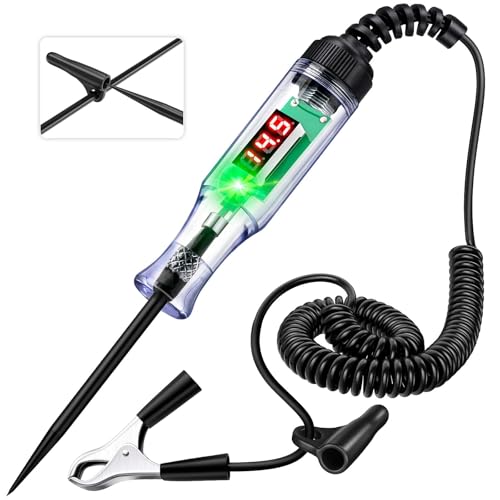
- INSTANT AND ACCURATE VOLTAGE READINGS: This professional digital test...
- AVOID COSTLY CONNECTION ERRORS: Stay safe and protect sensitive...
- BUILT TO SURVIVE THE BUSY WORKSHOPS: This electrical tester boasts a...
The FEAOXYO Heavy Duty Automotive Test Light Circuit Tester brings a 3-48V digital voltmeter and a dual polarity indicator into a single pen, which is a lot of function for a compact tester. The stainless probe is built for repeated fuse and connector work, and the 3-48V range covers standard 12V and 24V systems. I like that it’s rated for car, truck, RV, and boat fuse testing, so it earns a spot in a garage that works on more than one vehicle type.
This is best for someone who wants both a number and a polarity color without stepping up to a longer-wire tester. The honest catch: at 3-48V it stops short of the 65V and 72V testers higher on this list, so if you ever work on higher-voltage circuits, you’ll want more range.
✅ Pros
- 3-48V digital voltmeter shows real numbers
- Dual polarity indicator for direction at a glance
- Stainless probe holds up to repeated use
- Rated for car, truck, RV, and boat fuse testing
❌ Cons
- 3-48V cap won’t cover higher-voltage circuits
- Shorter lead than the long-wire testers
Piercing probe tip
JASTIND Heavy Duty Automotive Circuit Tester
6-24V | Sharp Piercing Probe | Extended Spring Test Leads | Replacement Indicator Light

- 【Extra Spring Light Bulb】 : High visibility and strictly tested...
- 【Quality Made Fuse Tester】 : Heavy Duty Construction, large size...
- 【135 Inch PU Spring Cord】 : Portable 135 inch long enough PU...
The JASTIND Heavy Duty Automotive Circuit Tester is the classic bulb-style test light, and the sharp piercing probe is the feature that sets it apart. That probe lets me stab through wire insulation to test a live circuit without hunting for an exposed connector. The extended spring test leads give a decent reach, and it comes with a replacement indicator light so a burnt bulb doesn’t sideline it.
This is best for old-school troubleshooting where you want a simple glow and a probe that bites into wire. The limitation: at 6-24V it has the narrowest range here, and there’s no voltmeter, so you get a pass/fail light rather than a number. If you need to read voltage, look higher up this list.
✅ Pros
- Sharp piercing probe bites into insulation
- Extended spring test leads for reach
- Comes with a replacement indicator light
❌ Cons
- 6-24V is the narrowest range in this group
- No voltmeter, just a pass/fail glow
- Piercing probe leaves small holes in insulation
Voltmeter readout
JASTIND Automotive Test Light with 3-48V LED Digital Readout
3-48V | LED Digital Readout | Voltmeter | Polarity Indicator | Stainless Probe
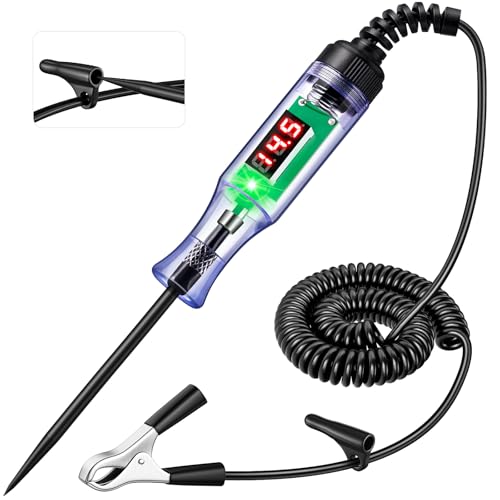
- ACCURATE LED DIGITAL READOUTS: This automotive test light allows you...
- BUILT TO LAST: Sharp, rugged stainless steel probe easily penetrates...
- EXTRA LONG REACH FOR EASY OPERATION: 96 inches of high-quality...
The JASTIND Automotive Test Light with 3-48V LED Digital Readout pairs a voltmeter with a polarity indicator light, so I can see both the number and the direction on one pen. The 3-48V range covers everyday 12V and 24V checks, and the stainless probe is built to hold up to fuse and connector poking. It’s a compact, readout-style tester that fits neatly in a home garage drawer.
This is best for the home garage doing routine fuse and voltage checks where a digital number helps you spot a sag. The honest limitation: the 3-48V ceiling means it won’t reach the higher voltages the 65V and 72V testers cover, and the shorter lead is less handy for long reaches across a big truck.
✅ Pros
- LED digital readout shows actual voltage
- Polarity indicator light for quick direction checks
- 3-48V range suits standard car work
- Stainless probe for durability
❌ Cons
- 3-48V ceiling skips higher-voltage systems
- Shorter lead limits long reaches
Long steel probe
FEAOXYO Test Light Automotive
6V-12V-24V DC | Alligator Clip | Long Steel Probe | Continuity Tester

- SAFE & STURDY: This automotive test light features an ergonomic...
- HIGH BRIGHTNESS BULB: Built-in a quality bulb in this electric tester...
- BIDIRECTIONAL CURRENT VOLTAGE TESTING: Simply connect the large size...
The FEAOXYO Test Light Automotive is a basic 6V-12V-24V DC circuit tester with a long steel probe and an alligator clip, and it does the simple continuity and fuse checks without any extra fuss. The long steel probe reaches into tight spots, and the alligator clip makes grounding quick. It’s rated for sedans, SUVs, RVs, and trucks, so it fits a general home garage.
This is best for someone who wants a no-frills tester for quick continuity and fuse checks on standard 12V and 24V vehicles. The real limitation: with just 6V-12V-24V coverage and no digital readout or polarity indicator, it’s the most basic tester here, so you’ll want one of the readout testers above if you need voltage numbers.
✅ Pros
- Long steel probe reaches tight spots
- Alligator clip for quick grounding
- Rated for sedan, SUV, RV, and truck
❌ Cons
- No digital readout or polarity indicator
- 6V-12V-24V coverage only, no wider range
- Most basic tester in this group
What to Look for in automotive circuit testers for home garage
Picking the right circuit tester for a home garage comes down to matching the tool to the vehicles you actually work on, and the biggest mistake buyers make is grabbing the cheapest pen without checking its voltage range. A tester that can’t handle your truck’s 24V system or that gives you no readout will leave you guessing. Here’s what I check before recommending any of these.
Voltage Range
The voltage range is the first thing I look at, because it decides which vehicles the tester can safely handle. A 3-48V tester covers most 12V and 24V car and truck work, while a 3-65V or 3-72V unit gives you extra headroom for higher-voltage circuits. A narrow 6-24V range is fine for basic automotive checks but will run out of room on some systems. My rule of thumb: buy more range than you think you need, since it costs little and saves you from a second purchase later.
Digital Readout vs. Pass/Fail Light
There are two flavors of tester: a plain bulb-style light that glows when there’s power, and a digital unit that shows an actual voltage number. A pass/fail light tells you a circuit is live, but a voltmeter readout tells you how much voltage is there, which is what you need to spot a sag or a bad ground. If you’re just checking whether a fuse has power, a simple light is enough. For real diagnostics, I’d always pick a tester with a digital display.
Polarity Indicator
A dual color polarity indicator is a small feature that saves real time. It shows you which side is positive and which is negative at a glance, so you don’t have to trace the circuit or flip your probe around. On a bidirectional tester, it also tells you the tester is reading in the right direction. I consider this a near-must for anyone doing more than the most basic checks, because it removes a common source of confusion.
Wire Length and Probe Type
Wire length matters more than people expect, especially in a home garage where you might be reaching from one end of a truck bed to the other. Long spring or PU wires in the 135 to 140-inch range give you that reach without dragging a jumper lead around. The probe type matters too: a sharp piercing probe lets you stab through insulation to test a wire, while a stainless probe is better for poking into connectors and fuse slots. Match the probe to the work you do most.
Build Quality and Durability
These testers get dropped, yanked, and shoved into tight spots, so the build matters. I look for heavy-duty housings, stainless probes that won’t bend on the first tough connector, and alligator clips that actually grip a battery post. A tester that comes with a replacement indicator light is a bonus, since a burnt bulb won’t leave you stuck. Durability is one of those things you don’t think about until a cheap unit fails mid-job.
Extra Features Like Buzzers and Backlighting
A few features push a tester from good to genuinely handy in a home garage. An audible buzzer lets you confirm a live circuit without looking, which is a lifesaver when you’re upside down under a dash. A backlit display keeps numbers readable in a dim garage. Neither is essential, but if you work in awkward spots or low light, they’re worth having. Just know a buzzer can get loud and tiresome on long sessions.
My Shortcut Advice: Buy the widest voltage range you can find with a digital readout and a polarity indicator — that combo handles almost every home garage job and keeps you from needing a second tester later.
Frequently Asked Questions
What is the best automotive circuit tester for a home garage?
The JASTIND Heavy Duty 3-65V Backlit Digital LCD Circuit Tester is the best all-around pick. It covers a 3-65V range, which handles 12V and 24V systems with headroom, and the 140-inch extended spring wire gives you the longest reach in this group. The backlit LCD and stainless probe make it easy to read in a dim garage. If you want a voltage readout but don’t need the long wire, the AWBLIN 3-60V is a strong second.
Do I need a digital circuit tester or is a plain test light enough?
A plain test light only tells you a circuit is live, while a digital tester shows the actual voltage number. If you’re just checking whether a fuse has power, a bulb-style light like the JASTIND 6-24V piercing-probe model does the job. But for real diagnostics — spotting a voltage drop or a weak ground — I’d always go digital. The number is what tells you something is wrong, not just that power is present.
What voltage range should I look for in a circuit tester?
Buy more range than you think you need. A 3-48V tester covers most 12V and 24V car and truck work, and the 3-65V and 3-72V testers give you extra headroom for higher-voltage circuits. A narrow 6-24V unit is fine for basic checks but runs out of room on some systems. The EVOULTES 3-72V has the widest range here, and the JASTIND 3-65V is close behind.
What’s the difference between a bidirectional tester and a standard one?
A bidirectional tester reads voltage correctly whether you clip the lead to power or to ground, so you don’t have to worry about orientation. A standard tester expects you to connect it a certain way. On a bidirectional unit like the AWBLIN 3-60V or the EVOULTES 3-72V, the dual color polarity indicator also shows you which side is positive at a glance. That removes a common source of confusion when you’re working fast.
Is a buzzer tester worth it for garage work?
Yes, if you work in awkward spots. The EVOULTES 3-72V buzzer lets you confirm a live circuit without looking at the tester, which is a lifesaver when you’re upside down under a dash. The catch is that the buzzer can get loud and tiresome on long troubleshooting sessions. If you mostly work in good light and can see the display, a silent tester is just as good.
How long should the test lead be on a circuit tester?
Longer is generally better for a home garage. Testers here range from compact pens up to the 140-inch spring wire on the JASTIND 3-65V and the 135-inch PU wire on the WINAMOO Professional. A long lead lets you reach from one end of a truck to the other without dragging a jumper around. If you only work up close on one vehicle, a shorter compact tester is easier to store.
Can a circuit tester check a fuse without removing it?
Yes, that’s one of the most common uses. You touch the probe to the small exposed test points on top of the fuse and check for voltage on both sides — if one side is live and the other isn’t, the fuse is blown. A tester with a stainless probe and a digital readout makes this quick and clear. The FEAOXYO 3-48V and JASTIND 3-48V readout models are both well suited to fuse testing.
Are cheap circuit testers worth it?
For basic checks, absolutely — a simple tester does the job and won’t hurt your wallet. But if you want a voltage readout, a polarity indicator, or a long lead, spending a little more gets you a tool you’ll actually rely on. My advice is to skip the absolute cheapest pen if you plan to do real diagnostics. Buy the widest range with a digital readout you can find, and you won’t need to upgrade later.
My Final Verdict
The JASTIND Heavy Duty 3-65V Backlit Digital is my overall best pick for a home garage. It wins on three things: a 3-65V range that covers 12V and 24V work with headroom, the 140-inch extended spring wire for reaching across a bay, and a backlit LCD that stays readable in a dim garage. The AWBLIN 3-60V is my best for voltage readout, with a built-in voltmeter and auto bidirectional testing. The EVOULTES 3-72V is my best for noisy checks, thanks to its audible buzzer and the widest 3-72V range here.
If you want one tester that handles almost everything, go with the JASTIND 3-65V. If reading exact voltage matters most, the AWBLIN 3-60V is your pick. If you work in tight, dark spots and want to hear a live circuit, grab the EVOULTES 3-72V. Any of the three will serve a home garage well.
Best overall: JASTIND Heavy Duty 3-65V Backlit Digital
- 【Wide testing range & Voltage Polarity Testing】3-65v low DC volt...
- 【Computer Safe & Backlight Digital Display Part】Heavy Duty circuit...
- 【Quality Made Tester Body】Professional automotive circuit tester...
Buy this if you want one tester that covers the most ground in a home garage. The 3-65V range and 140-inch spring wire handle mixed car and truck work without a second tool.
Best for voltage readout: AWBLIN Automotive Test Light 3-60V DC Digital
- [UNIQUE DESIGN- ANTI-LOST NEEDLE GUARD PROTECTION]: Adopt the...
- [LED INDICATION, BIDIRECTIONAL VOLTAGE TESTING]: This upgrade circuit...
- [WIDER VOLTAGE RANGE] Compared with the auto electrical tester on the...
Buy this if you need to read exact voltage, not just see a glow. The built-in voltmeter and auto bidirectional testing make voltage-drop chasing fast and clear.
Best for noisy checks: EVOULTES Upgraded 3-72V Buzzer Automotive Test Light
- [3-72 V Wide Testing Range] This professional automotive circuit...
- [Buzzing Bidirectional Voltage Testing Mode] You can attach the...
- [Computer Safe Accurate LED Digital Reading] Digital LED voltage...
Buy this if you work in tight, dark spots where you can’t see the tester. The audible buzzer confirms a live circuit hands-free, and its 3-72V range is the widest here.