
Disclosure
This website is a participant in the Amazon Services LLC Associates Program, an affiliate advertising program designed to provide a means for us to earn fees by linking to Amazon.com and affiliated sites.
The KAIWEETS Digital Multimeter TRMS 6000 Counts is the best digital multimeter for hobbyists because its 6000-count auto-ranging display reads voltage, current, resistance, capacitance, and temperature in one unit. I compared 9 models and ranked them best to worst.
- Best overall: KAIWEETS TRMS 6000 — 6000 counts plus temperature and capacitance
- Best for temperature and capacitance: AstroAI TRMS 6000 — 6000 counts with temperature and duty-cycle
- Best for battery testing: AstroAI Multimeter Tester — 1.5v/9v/12v battery tester with NCV
I picked these based on the listed specs: display counts, which measurements each meter covers, and whether it includes extras like non-contact voltage or temperature. I did not test them by hand, so treat this as a spec comparison, not a bench test. The goal is to match the right feature set to how you actually tinker.
Quick Comparison: best digital multimeters for hobbyists
| # | Product | Best For | Key Spec | Price |
|---|---|---|---|---|
| 1 | KAIWEETS TRMS 6000 Best overall |
All-round hobby work | 6000 counts | Check Price → |
| 2 | AstroAI TRMS 6000 Best for temperature and capacitance |
Temp and capacitor checks | 6000 counts | Check Price → |
| 3 | AstroAI Multimeter Tester Best for battery testing |
Checking household batteries | 4000 counts | Check Price → |
| 4 | Crenova MS8233D Live wire test included |
Frequency and live wire | 6000 counts | Check Price → |
| 5 | Klein Tools MM325 Manual-ranging 600V |
Simple voltage testing | 600V AC/DC | Check Price → |
| 6 | TESMEN TM-510 Smart auto-ranging |
Quick no-contact checks | 4000 counts | Check Price → |
| 7 | AstroAI 2000 Counts Basic entry-level meter |
First-time beginners | 2000 counts | Check Price → |
| 8 | ANENG with Case Comes with a case |
Outlet and battery checks | Carry case | Check Price → |
| 9 | FNIRSI DMT-99 Rechargeable with data mode |
Recording and monitoring | 9999 counts | Check Price → |
How I Selected These Products
I started with the specs that actually matter for hobby work: display counts, whether the meter is auto-ranging or manual, and which measurements it covers. Voltage, current, resistance, and continuity were the baseline. Anything with capacitance, temperature, or frequency got extra credit.
Then I looked at real-world usability. Non-contact voltage detection, battery testing modes, and a clear auto-ranging display make a meter easier to grab for quick jobs. I ranked models higher when those features matched how hobbyists actually work at a bench.
Finally, I weighed how each meter’s feature set held up across the lineup, not just on paper. A high count display means little if the measurement modes are thin. The models that ranked highest covered the most ground without forcing you to guess.
Best overall
KAIWEETS Digital Multimeter TRMS 6000 Counts Voltmeter Auto-Ranging Fast Accurately Measures Voltage Current Amp Resistance Diodes Continuity Duty-Cycle Capacitance Temperature for Automotive
TRMS | 6000 Counts | Auto-Ranging | Temperature | Capacitance
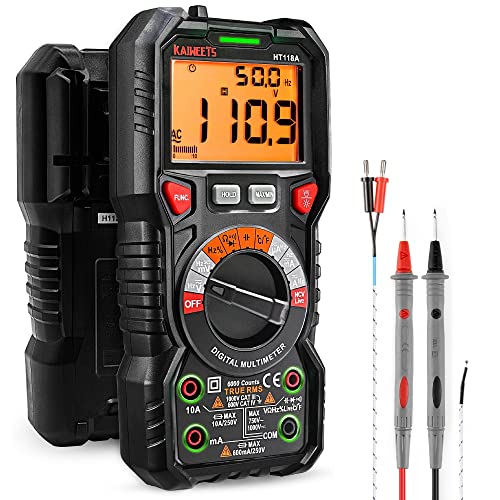
- WIDE APPLICATIONS: KAIWEETS HT118A Multimeter measures up to 1000V DC...
- EASY OPERATION: Switch the dial to the function you need, and the LED...
- MULTI-FUNCTION: Non-contact voltage testing and Live function with...
The KAIWEETS Digital Multimeter TRMS 6000 Counts tops my list because it covers basically everything a hobbyist needs in one unit. You get true RMS readings, 6000 counts for finer resolution, and auto-ranging so you’re not fiddling with dials. It also handles capacitance, duty-cycle, and temperature, which is more than most meters in this group offer.
This is the meter I’d grab for general bench work, automotive checks, and anything where I want temperature readings too. The honest catch: it packs a lot in, so the interface takes a little learning if you’re brand new. If you just want voltage and continuity, a simpler meter will do.
✅ Pros
- 6000 counts for fine resolution
- TRMS for accurate AC readings
- Measures temperature and capacitance
- Auto-ranging saves setup time
❌ Cons
- Busy interface takes some learning
- Overkill if you only need basic readings
Best for temperature and capacitance
AstroAI Digital Multimeter and Analyzer TRMS 6000 Counts Volt Meter Ohmmeter Auto-Ranging Tester; Accurately Measures Voltage Current Resistance Diodes Continuity Duty-Cycle Capacitance Temperature
TRMS | 6000 Counts | Auto-Ranging | Temperature | Duty-Cycle

- Versatile Digital Multimeter - Accurately measures AC/DC Current...
- Thoughtful Design - Support Data Hold, Large LCD Backlit Screen, Auto...
- Suitable For Many Occasions - This Multimeter is a golden partner to...

The AstroAI Digital Multimeter and Analyzer TRMS 6000 Counts is a near twin to my top pick on paper. It gives you 6000 counts, TRMS accuracy, and auto-ranging, plus temperature and duty-cycle coverage. For checking capacitors or reading temperature on a project, it does the job without complaint.
This is a great fit if temperature and capacitance are the readings you reach for most. The limitation is simple: it overlaps heavily with the KAIWEETS, so there’s little reason to own both. Pick this one if the feature match suits you and the other isn’t available.
✅ Pros
- 6000 counts and TRMS accuracy
- Temperature and duty-cycle coverage
- Auto-ranging for quick setup
❌ Cons
- Overlaps heavily with the top pick
- No reason to own alongside #1
Best for battery testing
AstroAI Multimeter Tester
TRMS | 4000 Counts | Auto-Ranging | NCV | Battery Tester

- Wide Application - The AstroAI M4K0R Multimeter accurately measures...
- Non-Contact - Fully safe non-contact voltage testing with sound and...
- Thoughtful Design - Support Data Hold, Max, Auto Shut-off, low battery...
The AstroAI Multimeter Tester is the one I’d hand to someone who keeps a drawer full of dying batteries. It has dedicated 1.5v, 9v, and 12v battery voltage testing, which is exactly what hobbyists check most. You still get TRMS, 4000 counts, auto-ranging, and non-contact voltage detection.
This is best for battery testing and quick household checks rather than deep bench work. The trade-off is resolution: 4000 counts is coarser than the 6000-count meters above, so very fine measurements aren’t its strong point. For everyday battery and outlet checks, though, it’s plenty.
✅ Pros
- Dedicated 1.5v/9v/12v battery testing
- NCV for non-contact voltage checks
- TRMS and auto-ranging
❌ Cons
- 4000 counts is coarser resolution
- No temperature measurement
Live wire test included
Crenova MS8233D Multimeter 6000 Counts Digital Multimeter DC AC Volt Meter Ohm Volt Amp Tester Measures Voltage Current Resistance Capacitance Continuity Diode Duty-Cycle Frequency NCV Live Wire Test
6000 Counts | NCV | Live Wire Test | Frequency | Duty-Cycle
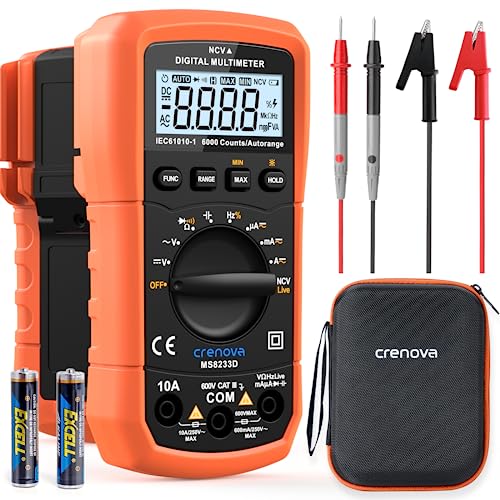
- 【More Versatile than Expected】MS8233D multimeter can accurately...
- 【User and Device Protection】The digital multimeter conforms to...
- 【6000-Count LCD Screen】Equipped with a 6000-count (3 5/6 digits...
The Crenova MS8233D Multimeter 6000 Counts covers a lot of ground for the money. You get 6000 counts, capacitance, continuity, diode, duty-cycle, and frequency, plus NCV and a live wire test. That live wire test is a nice safety touch you don’t see on every meter in this range.
This suits hobbyists who want frequency and live wire checks without stepping up to a pricier unit. The honest limitation: it lacks temperature measurement, so if you need that, look at the two 6000-count meters above. For everything else, it’s a capable all-rounder.
✅ Pros
- 6000 counts with frequency measurement
- NCV plus live wire test
- Capacitance and duty-cycle included
❌ Cons
- No temperature measurement
- Busy feature set to learn
Manual-ranging 600V
Klein Tools MM325 Multimeter
Manual-Ranging | 600V AC/DC | Battery Test | Diodes | Continuity
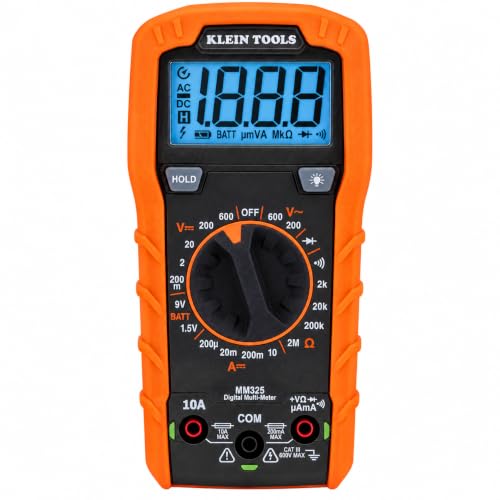
- VERSATILE FUNCTIONALITY: Measures AC/DC voltage up to 600V, 10A DC...
- LEAD-ALERT PROTECTION: LEDs on the meter illuminate to indicate proper...
- BACKLIT DISPLAY: LCD shows clear readings in low-light conditions for...
The Klein Tools MM325 Multimeter is the simple, no-nonsense option on this list. It’s a manual-ranging meter rated to 600V AC/DC, and it tests batteries, current, resistance, diodes, and continuity. If you like setting the range yourself instead of trusting an auto-ranging circuit, this is your meter.
This is best for straightforward voltage testing and basic continuity checks. The honest limitation: it’s manual-ranging and skips capacitance and temperature, so it’s not the pick for capacitor or thermal work. If you want a dead-simple meter for voltage and continuity, though, it’s a solid choice.
✅ Pros
- Manual-ranging for hands-on control
- Rated to 600V AC/DC
- Tests batteries, diodes, and continuity
❌ Cons
- Manual-ranging takes more setting up
- No capacitance or temperature
Smart auto-ranging
TESMEN TM-510 Digital Multimeter
4000 Counts | Smart Measurement | Auto-Ranging | NCV | Green

- Smart Digital Multimeter: Thanks to its Smart Auto Mode, TESMEN TM...
- Non-contact: Completely safe Non-Contact Voltage test with a visual...
- Safety Guarantee: CAT II 600V, CE, and RoHS certified. Overload...
The TESMEN TM-510 Digital Multimeter leans on its smart measurement mode to keep things simple. It’s a 4000-count auto-ranging voltmeter that reads AC/DC voltage, resistance, and continuity, and it adds non-contact voltage detection. For a quick grab-and-go meter, the simplified measurement flow is genuinely handy.
This is best for quick no-contact checks and everyday voltage work around the house. The limitation is scope: it sticks to voltage, resistance, and continuity, so it skips capacitance, temperature, and current. If you need those, the higher-ranked meters cover more.
✅ Pros
- Smart measurement simplifies use
- 4000 counts with auto-ranging
- Non-contact voltage function
❌ Cons
- No capacitance or temperature
- Skips current measurement
Basic entry-level meter
AstroAI Digital Multimeter Tester 2000 Counts with DC AC Voltmeter and Ohm Volt Amp Meter; Measures Voltage
2000 Counts | DC/AC Voltmeter | Ohm/Volt/Amp | Blue
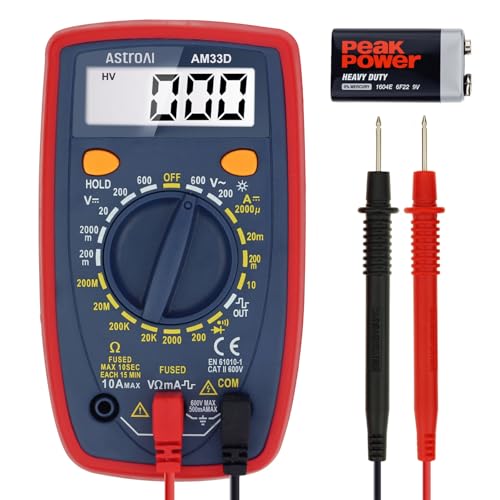
- Additional Tips - The following incorrect operations may cause the...
- Versatile Digital Multimeter - Accurately measures AC/DC Voltage, DC...
- Troubleshooting with Accuracy - This Multimeter has a sampling speed...
The AstroAI Digital Multimeter Tester 2000 Counts is the stripped-down starter on this list. It measures voltage, current, resistance, continuity, and diode, which covers the basics any beginner needs. At 2000 counts it won’t win a precision contest, but it’s a clean, simple first meter.
This is best for first-time beginners who want to learn the ropes without a busy interface. The honest limitation is resolution: 2000 counts is the lowest here, and it skips capacitance, temperature, and NCV. If you plan to grow into finer work, start higher up the list.
✅ Pros
- Covers voltage, current, resistance, diode
- Simple interface for beginners
- Straightforward continuity testing
❌ Cons
- 2000 counts is the lowest resolution here
- No capacitance, temperature, or NCV
Comes with a case
ANENG Digital Multimeter with Case
Carry Case | DC/AC Voltmeter | Ohm/Volt/Amp | Diode

- Versatility: ANENG multi meter is a highly adaptable electronic tool...
- Precision: Multimetro typically have two probes that can be inserted...
- User-friendly display: ANENG Multi Tester have a clear and...
The ANENG Digital Multimeter with Case brings the basics plus a carry case, which is a small thing that makes a real difference for keeping your gear together. It measures voltage, current, resistance, continuity, and diodes, and it’s aimed at household outlet and automotive battery checks.
This is best for hobbyists doing outlet and battery checks who want their meter protected between jobs. The honest limitation: it’s a basic feature set with no capacitance, temperature, or NCV. It’s a simple tool, and that’s fine if simple is all you need.
✅ Pros
- Includes a carry case
- Measures voltage, current, resistance, diode
- Suited to outlet and battery checks
❌ Cons
- No capacitance or temperature
- No non-contact voltage detection
Rechargeable with data mode
FNIRSI DMT-99 Digital Multimeter 9999 Counts TRMS
9999 Counts | TRMS | Rechargeable | Data Recording | NCV
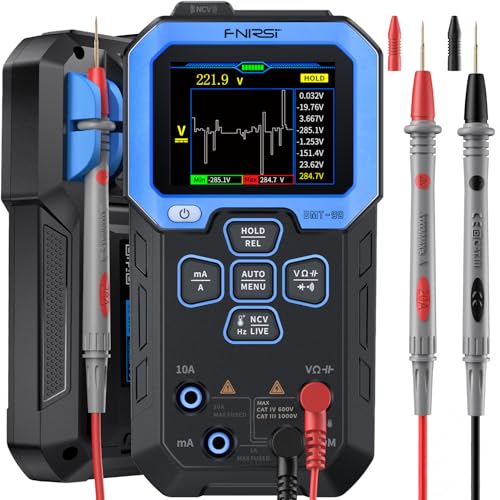
- 【9999 Counts & Rechargeable】FNIRSI DMT-99 digital multimeter...
- 【Smart Auto-Identification】Streamline troubleshooting with...
- 【Graphic Waveform & Monitoring】This automotive multimeter plots...
The FNIRSI DMT-99 Digital Multimeter 9999 Counts TRMS is the most feature-dense meter here. It has the highest count on this list at 9999, true RMS readings, and a rechargeable battery so you’re not hunting for cells. It also adds recording and monitoring data mode, plus capacitance, frequency, diode, and NCV.
This is best for hobbyists who like recording and monitoring readings over time, like watching a value drift on a project. The honest limitation: the data mode and rechargeable setup add complexity, so it’s not the simplest pick for a quick voltage check. It rewards someone who’ll use the extras.
✅ Pros
- 9999 counts, the highest here
- Rechargeable battery
- Recording and monitoring data mode
- TRMS with capacitance and frequency
❌ Cons
- Data mode adds complexity
- Overkill for a quick voltage check
What to Look for in digital multimeters for hobbyists
Picking the right multimeter matters because the wrong one either can’t measure what you need or buries the basics under menus you’ll never touch. The biggest mistake I see is buying by count number alone and ignoring which measurements the meter actually covers. A high display count means nothing if it can’t read capacitance or temperature when your project needs them.
Display Counts and Resolution
Counts tell you how finely a meter can resolve a reading. The range in this lineup runs from 2000 counts up to 9999 counts, and that gap is real. For basic voltage and continuity checks, 2000 is fine. For finer work, 4000 or 6000 counts gives you more digits to work with, and 9999 counts is the sharpest you’ll find here. My rule of thumb: if you’re just starting out, don’t overpay for counts you won’t use, but don’t go below 4000 if you plan to grow into the hobby.
Auto-Ranging vs. Manual-Ranging
Auto-ranging meters set the range for you, which speeds up everyday checks and reduces the chance of a wrong setting. Manual-ranging meters make you pick the range, which gives more control but takes more attention. Most of the meters here are auto-ranging, and that’s the friendlier choice for hobbyists who switch between tasks. I’d only reach for manual-ranging if you specifically like dialing in each measurement yourself.
Which Measurements Are Covered
Every meter here does voltage, resistance, and continuity, so that’s the floor. Where they split is on capacitance, temperature, frequency, duty-cycle, and current. If you work with capacitors or check thermal behavior, you need a meter that lists capacitance and temperature. If you’re mostly testing batteries and outlets, you can skip those extras and save the complexity. Match the measurement list to what you actually do, not to what sounds impressive.
Safety and Convenience Features
Non-contact voltage detection (NCV) lets you check for live wires without touching them, and a live wire test adds another layer of safety. These features matter more than people think when you’re poking around household outlets. A rechargeable battery, like on the highest-count meter here, saves you from hunting for cells. A carry case is a small perk that keeps the meter and leads together between projects.
True RMS Accuracy
True RMS matters when you measure AC signals that aren’t clean sine waves, which comes up in electronics work. Several meters here list TRMS, and it’s worth having if you’ll read anything beyond simple household voltage. For pure DC battery checks, plain RMS is plenty. My take: if the meter is TRMS and everything else fits, treat it as a bonus rather than the deciding factor.
Build and Everyday Usability
A meter you actually enjoy picking up gets used more than one that fights you. Look at how busy the interface is and whether the measurement flow feels simple or cluttered. The smart measurement and data modes on some models are great if you’ll use them, but they add steps if you won’t. I’d rather have a slightly plainer meter I understand than a feature-packed one I second-guess every time.
My Shortcut Advice: Buy for the measurements you’ll actually use, not the biggest count number. A 4000-count meter with capacitance and NCV beats a higher-count meter that can’t read what your projects throw at it.
Frequently Asked Questions
What is the best digital multimeter for hobbyists overall?
The KAIWEETS Digital Multimeter TRMS 6000 Counts is my pick for most hobbyists. It gives you 6000 counts, true RMS readings, auto-ranging, and it covers voltage, current, resistance, diodes, continuity, duty-cycle, capacitance, and temperature in one unit. That combination means you won’t need a second meter when a project shifts from battery checks to capacitor work. For a do-everything bench meter, it’s the one I’d buy first.
How many counts do I need in a multimeter?
For basic voltage and continuity checks, 2000 counts is enough, and it’s the lowest resolution on this list. I’d step up to 4000 or 6000 counts if you plan to do finer work, since more counts means more digits to read small changes. The FNIRSI DMT-99 goes all the way to 9999 counts, which is the sharpest here. My rule: don’t buy below 4000 if you expect to grow into the hobby.
Do I need a true RMS multimeter for hobby work?
True RMS matters when you measure AC signals that aren’t clean sine waves, which comes up in electronics tinkering. Several meters here list TRMS, including the KAIWEETS, both AstroAI models, and the FNIRSI. For plain DC battery checks, you don’t strictly need it. If the meter is TRMS and everything else fits your needs, treat it as a bonus rather than the deciding factor.
What’s the difference between auto-ranging and manual-ranging multimeters?
Auto-ranging meters set the range for you, so you spend less time dialing and more time measuring. Manual-ranging meters make you pick the range yourself, which gives more control but takes more attention. Most meters on this list are auto-ranging, and the Klein Tools MM325 is the manual-ranging pick here. I’d choose auto-ranging for everyday hobby work and manual only if you specifically like setting each range.
Can a multimeter test batteries and household outlets?
Yes, and several meters here are built for exactly that. The AstroAI Multimeter Tester has dedicated 1.5v, 9v, and 12v battery voltage testing, and the ANENG with Case is aimed at household outlet and automotive battery checks. For outlets, look for non-contact voltage detection or a live wire test, which the Crenova MS8233D includes. Just remember a meter reads voltage, it doesn’t tell you if an outlet is wired correctly beyond that.
Is a multimeter with NCV worth it?
I think so, especially if you’ll poke around outlets or wiring. Non-contact voltage detection lets you check for live wires without touching them, which is a real safety plus. The AstroAI Multimeter Tester, Crenova MS8233D, TESMEN TM-510, and FNIRSI DMT-99 all include NCV. If your work stays on low-voltage DC projects, you can skip it without much loss.
How do I measure capacitance and temperature with a multimeter?
You need a meter that lists both functions, then you select that mode and connect the component or probe. The KAIWEETS TRMS 6000 and AstroAI TRMS 6000 both cover capacitance and temperature, which is why they rank at the top. The Crenova MS8233D and FNIRSI DMT-99 handle capacitance but not temperature. If thermal readings matter, check the spec list before buying.
Is an expensive multimeter worth it for a beginner?
Not necessarily. A simpler meter like the AstroAI 2000 Counts covers voltage, current, resistance, continuity, and diode, which is plenty to learn on. The trade-off is resolution and missing features like capacitance and NCV. I’d start simple, learn the basics, then upgrade once you know which measurements you actually reach for. Buying every feature up front often means paying for modes you never touch.
My Final Verdict
The KAIWEETS Digital Multimeter TRMS 6000 Counts is the best overall pick, and I’d buy it again without hesitation. Three reasons stand out: 6000 counts give you fine resolution, TRMS keeps AC readings honest, and it covers capacitance, temperature, and duty-cycle so you’re not stuck when a project shifts gears. If temperature and capacitance are your main readings, the AstroAI TRMS 6000 is the best for temperature and capacitance. If you mostly test batteries, the AstroAI Multimeter Tester is the best for battery testing with its 1.5v/9v/12v modes.
Still undecided? If you want one meter that handles nearly everything, go with the KAIWEETS. If you’re just checking batteries and outlets, the AstroAI Multimeter Tester does that job well. And if you’re starting from zero, the AstroAI 2000 Counts keeps things simple and affordable while you learn the ropes.
Best overall: KAIWEETS TRMS 6000
- WIDE APPLICATIONS: KAIWEETS HT118A Multimeter measures up to 1000V DC...
- EASY OPERATION: Switch the dial to the function you need, and the LED...
- MULTI-FUNCTION: Non-contact voltage testing and Live function with...
Buy this if you want one meter that covers voltage, current, capacitance, temperature, and more. The 6000-count TRMS display and auto-ranging make it the most capable all-rounder here.
Best for temperature and capacitance: AstroAI TRMS 6000
- Versatile Digital Multimeter - Accurately measures AC/DC Current...
- Thoughtful Design - Support Data Hold, Large LCD Backlit Screen, Auto...
- Suitable For Many Occasions - This Multimeter is a golden partner to...
Buy this if temperature and capacitance readings are what you reach for most. It matches the top pick on counts and TRMS while covering both functions.
Best for battery testing: AstroAI Multimeter Tester
- Wide Application - The AstroAI M4K0R Multimeter accurately measures...
- Non-Contact - Fully safe non-contact voltage testing with sound and...
- Thoughtful Design - Support Data Hold, Max, Auto Shut-off, low battery...
Buy this if you keep a drawer of dying batteries and want a quick answer. Dedicated 1.5v/9v/12v testing plus NCV makes it the practical choice for everyday checks.