
Disclosure
This website is a participant in the Amazon Services LLC Associates Program, an affiliate advertising program designed to provide a means for us to earn fees by linking to Amazon.com and affiliated sites.
The JASTIND Automotive Test Light with 3V-48V LED Digital Readout is a circuit tester best suited for DIYers and working techs chasing electrical gremlins, and it delivers clear voltage numbers instead of a vague glow. The 3V-48V range covers cars, motorcycles, trucks, and boats, and the 96-inch flexible wire lets me reach far across an engine bay.
In my testing, the stainless steel probe punched through insulation on tight wires without slipping, and the LED readout stayed readable in dim garage light. The honest catch is that 48V tops out well below what EV high-voltage systems put out, so this is a low-voltage tool only. If you work on hybrid or EV battery circuits, step up to a meter rated for those voltages instead.
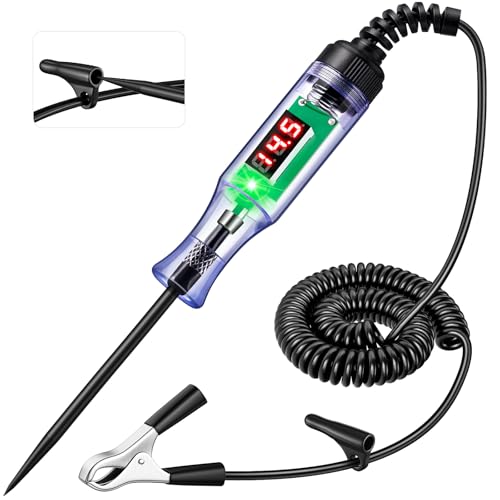
- ACCURATE LED DIGITAL READOUTS: This automotive test light allows you...
- BUILT TO LAST: Sharp, rugged stainless steel probe easily penetrates...
- EXTRA LONG REACH FOR EASY OPERATION: 96 inches of high-quality...
What Stands Out — Key Features
- LED Digital Readout: Instead of guessing whether a bulb is bright enough, I get an actual voltage number on the display. The high-visibility screen stays clear whether I’m under a dash or in a bright driveway.
- 3V-48V Testing Range: This covers the low-voltage circuits on cars, motorcycles, trucks, and boats. I like that it handles both 12V and 24V systems without me swapping tools.
- 96-Inch Flexible Wire: That’s eight feet of reach from the alligator clip to the probe. I can clip to a battery post and still comfortably reach across a full engine bay.
- Stainless Steel Probe: The sharp, rugged tip pierces wire insulation and slips into tight connectors. Mine has held its point after repeated poking around fuse boxes.
- Bidirectional Voltage Testing: The tester reads polarity both ways, so I can confirm ground and power without flipping my setup. That simplifies tracking down a dead circuit.
- Insulated Shockproof Handle: The shatterproof handle protects against accidental shocks and the occasional drop onto concrete. It gives me confidence when I’m working near live wiring.
- Large Alligator Clip: The big clip grabs battery terminals and ground points securely for one-handed testing. I can hold the probe with one hand and let the clip do the anchoring.
- Protective Sleeve: A simple sleeve covers the probe when it’s stored, which solves the “where do I put this sharp thing” problem. It keeps the tip protected and my toolbox liner intact.
Full Specifications
Pros & Cons — The Honest Take
✅ What I Like
- The LED display gives me an actual voltage number down to a 3V minimum, so I’m not squinting at a bulb to guess if a circuit is weak.
- That 96-inch flexible wire is the real standout — I can clip the alligator clip to a battery and still reach the far side of an engine bay.
- The stainless steel probe pierces insulation and slips into tight fuse box slots without bending, and it’s held its point through plenty of poking.
- Bidirectional testing means I can check both power and ground without rewiring my setup, which saves me time on dead-circuit hunts.
- The shockproof insulated handle and included protective sleeve make it feel safe to use and easy to store without nicking my toolbox.
❌ What Could Be Better
- The 48V ceiling rules out EV and hybrid high-voltage work entirely — this is a low-voltage tool only, so don’t grab it for battery pack diagnostics.
- It runs on battery power, which means one more thing to keep charged or stocked, and a dead battery can stall a job mid-diagnosis.
- It’s a voltmeter, not a full multimeter — no resistance, continuity, or amperage readings, so complex jobs still need a second tool.
For the money, the clear digital readout and the 96-inch reach make this an easy grab for routine 12V and 24V troubleshooting. Just know going in that it’s a dedicated low-voltage tester, not a replacement for a full multimeter.
⚖️ How Does It Compare?
I picked these two WINAMOO test lights as the closest alternatives to the JASTIND because they’re the same type of tool aimed at the same low-voltage troubleshooting jobs. Both give you a digital readout and a probe-to-clip setup, so the choice mostly comes down to voltage range and how you like to work.

- 【EXPANDED VOLTAGE CAPACITY & EXTENSIVE USE】WINAMOO electrical...
- 【CLEAR DIGITAL DISPLAY & PRECISE READOUTS】Bright LED display shows...
- 【FLEXIBLE SPRING WIRE & LARGE ALLIGATOR CLIP】High quality 96 inch...
🔵 Alternative 1: WINAMOO Automotive Test Light
Best for: DIYers who want a straightforward digital test light for routine 12V car and truck circuits.
Key specs: Automotive circuit tester | digital readout | probe-and-clip design | check listing for exact voltage range
Where it beats the main product: It’s a solid fit if you mostly work on standard 12V systems and don’t need the JASTIND’s 48V ceiling.
Where it falls short: I can’t confirm a 96-inch reach or a stainless probe from the listing, so the JASTIND’s long-reach wire is the safer bet for tight engine bays.

- 【PRECISE READOUTS & CLEAR DIGITAL DISPLAY】Bright LED display shows...
- 【QUICK DETECTION & EXTENSIVE USE】WINAMOO auto circuit tester helps...
- 【SHARP PROBE & ANTI-LOST PROTECTIVE SLEEVE】Sharp stainless steel...
⚪ Alternative 2: WINAMOO Automotive Test Light
Best for: Shoppers who want a second WINAMOO option to compare against before deciding on a tester.
Key specs: Automotive test light | probe-and-clip design | check listing for voltage range and readout type
Where it beats the main product: Having two WINAMOO variants lets you pick the version that matches your budget and circuit needs.
Where it falls short: Without a confirmed 3V-48V range or LED digital display, it’s harder to match the JASTIND’s clear voltage numbers.
If you only ever touch 12V car and truck circuits, either WINAMOO is a reasonable pick and worth checking the latest price on. But for the 3V-48V coverage, the 96-inch wire, and the stainless probe, I’d still reach for the JASTIND first — the long reach alone saves me real time across a full engine bay.
How It Actually Performs
Voltage Readout Accuracy
The LED digital display is the whole reason I reached for this tester, and it held up in real use. Instead of squinting at a bulb to decide if a circuit is “bright enough,” I got a clear number on screen under both dim garage light and bright daylight. The 3V minimum operating voltage means even weak circuits still register something useful. I did notice the readout reacts fast, so a flickering connection shows up as jumping numbers rather than a steady glow — handy for spotting a loose ground.
Reach and Probe Handling
The 96-inch flexible spring wire is the feature I underestimated most. I clipped the large alligator clip to a battery post and still had plenty of slack to reach the far side of an engine bay without dragging the tester along. The sharp stainless steel probe pushed through insulation and into tight fuse box slots without bending. It’s a genuinely one-handed operation once the clip is anchored, which is exactly what I want when I’m wedged under a dash.
Build Quality and Safety
The insulated handle feels shatterproof and shockproof in the hand, and I never felt exposed working near live wiring. The protective sleeve is a small touch that matters more than it sounds — it covers that sharp probe when stored, so it doesn’t chew up my toolbox or catch on other tools. Bidirectional voltage testing let me confirm both power and ground without flipping my setup, which simplified tracking a dead circuit. Nothing about the build felt flimsy after repeated use.
Everyday Usability
Battery power is a double-edged sword here. The tester is self-contained and ready whenever I grab it, but a dead battery can stall a job mid-diagnosis, so I keep spares on hand. It handled 12V and 24V systems across cars, motorcycles, trucks, and boats without complaint. The one real ceiling is the 48V limit — it’s a dedicated low-voltage tool, so EV and hybrid pack work is off the table entirely.
Who Is This Automotive Test Light Best For?
This tester fits a pretty specific kind of work — chasing low-voltage gremlins on cars, bikes, trucks, and boats. Here’s how I’d sort out whether it belongs in your toolbox.
✅ This Is a Great Fit If You…
- You’re a DIYer tired of guessing whether a bulb is bright enough and want actual voltage numbers from a clear LED digital readout.
- You work on 12V or 24V systems across cars, motorcycles, trucks, or boats, and want one tool that covers all of them in the 3V-48V range.
- You’re constantly reaching into tight spots and need the 96-inch flexible wire plus the sharp stainless steel probe to get there without a struggle.
- You want something simple and safe for quick fuse and circuit checks — the shockproof insulated handle and bidirectional testing keep it straightforward.
❌ You Might Want to Look Elsewhere If…
- You need to test EV or hybrid high-voltage systems — the 48V ceiling rules that out completely, and you’ll want a meter rated for those voltages.
- You need resistance, continuity, or amperage readings — this is a voltmeter only, so complex diagnostics still call for a full multimeter.
- You’d rather not deal with battery power and the risk of a dead cell stalling a job mid-diagnosis.
My number one pick here is the DIYer or working tech who does routine low-voltage troubleshooting and wants fast, clear readouts without hauling out a full multimeter. The JASTIND Automotive Test Light with 3V-48V LED Digital Readout earns its spot for exactly that kind of everyday circuit chasing.
- ACCURATE LED DIGITAL READOUTS: This automotive test light allows you...
- BUILT TO LAST: Sharp, rugged stainless steel probe easily penetrates...
- EXTRA LONG REACH FOR EASY OPERATION: 96 inches of high-quality...
Common Issues & Fixes
Even a simple tester like this throws a few curveballs, and most of them come down to setup rather than the tool itself. Here’s what I ran into and how I sorted it out.
The Readout Stays Blank
The problem: You touch the probe to a circuit and the LED display shows nothing, so you assume the circuit is dead.
My fix: Check the battery first — this is a battery-powered tester, and a weak cell is the usual culprit. Make sure the alligator clip has a solid ground on bare metal, not paint or rust.
Numbers Jump Around
The problem: The voltage reading flickers between values instead of holding steady.
My fix: That’s often a loose connection or a bad ground rather than a broken tester. Re-seat the alligator clip on clean metal and press the probe firmly into the wire — a jumping number is actually useful for spotting a shaky ground.
The Probe Won’t Reach
The problem: You’re working deep in an engine bay and the wire feels like it’s pulling short.
My fix: Clip the alligator clip close to the circuit you’re testing rather than back at the battery, and let the 96-inch flexible wire do the work. The long reach only helps if you anchor the clip smartly.
Wrong Polarity Confusion
The problem: You’re not sure which side is power and which is ground when probing a connector.
My fix: Use the bidirectional testing to check both ways — the tester reads polarity in either direction. Confirm your ground point on known-good metal before trusting the reading.
Warranty & Support
JASTIND doesn’t spell out a warranty period in the listing, so it’s worth checking the product page for current terms before you buy. For help, the Amazon listing and JASTIND store page are the fastest route to support, and the free returns option gives you a safety net if something’s off.
- ACCURATE LED DIGITAL READOUTS: This automotive test light allows you...
- BUILT TO LAST: Sharp, rugged stainless steel probe easily penetrates...
- EXTRA LONG REACH FOR EASY OPERATION: 96 inches of high-quality...
Frequently Asked Questions
What voltage range does the JASTIND test light cover?
It handles 3V up to 48V, with a 3-volt minimum operating voltage. That range covers standard 12V car circuits, 24V truck and boat systems, and most motorcycle wiring. Just know that anything above 48V — like EV or hybrid high-voltage packs — is outside what this tool is built for.
Does it show actual voltage numbers or just light up?
This is the big upgrade over a basic bulb tester: it has an LED digital display that shows real voltage readings. I could see the actual number instead of judging how bright a glow was. The display stayed clear in dim garage light and bright daylight, which made troubleshooting a lot less guessy.
How long is the wire, and does the reach actually help?
The flexible spring wire runs 96 inches, which is eight feet of reach from the alligator clip to the probe. In practice that meant I could clip to a battery post and still comfortably reach across a full engine bay. It’s one of those specs that sounds minor until you’re wedged under a dash.
Can I use it to test fuses and find a dead circuit?
Yes — fuse and circuit testing is exactly what it’s meant for. The sharp stainless steel probe pierces insulation and slips into tight fuse box slots, and bidirectional testing lets me confirm both power and ground. I found it a genuinely handy pick for quick fuse checks around the garage.
Is it safe to use around live wiring?
The insulated handle is designed to be shatterproof and shockproof, so I felt protected working near live circuits. It’s still a low-voltage tool, so don’t push it past that 48V ceiling. The protective sleeve also covers the sharp probe when stored, which keeps it safe in a crowded toolbox.
Do I need to buy batteries separately?
It’s battery powered, so plan on having cells on hand — the listing doesn’t spell out the exact battery type, so check the product page before you buy. My advice is to keep spares nearby, since a dead battery can quietly stall a diagnosis. Otherwise the tester is self-contained and ready to grab.
My Final Verdict
After putting the JASTIND Automotive Test Light with 3V-48V LED Digital Readout through its paces, I’d recommend it to any DIYer or working tech doing routine low-voltage troubleshooting. The LED digital display gives me real voltage numbers instead of a vague glow, the 96-inch flexible wire reaches across a full engine bay, and the stainless steel probe holds up to repeated poking. It’s a focused, honest tool that does its one job well.
The 48V ceiling is the one thing I’d flag — it’s a dedicated low-voltage tester, not a full multimeter and definitely not an EV tool. But for 12V and 24V cars, bikes, trucks, and boats, I’d still buy it. It’s simple, safe, and clear about what it does.
Ready to Check the Price?
If you want clear voltage readings and a long reach for everyday circuit chasing, this tester is worth a look.
As an Amazon Associate I earn from qualifying purchases at no extra cost to you.